
 Mobile Generator


China’s Energy Storage Solutions: A Key to South Africa’s Just Energy
China leads the world in energy storage solutions. Their technology delivers real results for countries seeking affordable and reliable power. South Africa trusts these innovations because they offer proven performance. Many communities see hope for a brighter future with these solutions.
Key Takeaways
- China’s advanced energy storage technologies help South Africa reduce power outages by storing extra renewable energy and releasing it when needed, making the power supply more stable and reliable.
- Strong partnerships between China and South Africa bring affordable, scalable, and safe energy storage solutions that create jobs, support local communities, and promote a fair energy transition.
- Building local skills and clear government support are essential to overcome challenges and ensure long-term success and sustainability of energy storage projects in South Africa.
South Africa’s Energy Challenges and the Need for Solutions
Power Shortages and Grid Instability
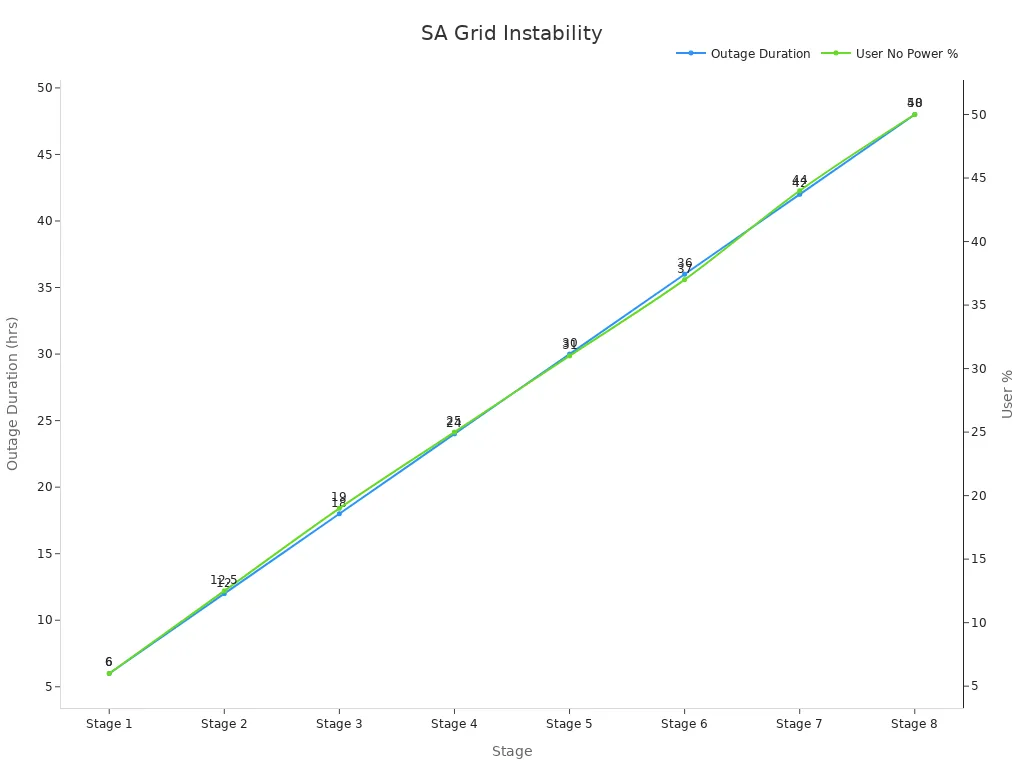
South Africa faces frequent power shortages that disrupt daily life and economic activity. Rolling blackouts, known as loadshedding, often last between 2.5 to 4 hours. The number of outages per month increased from 4 in 2019 to 9 in 2020. In 2018, people experienced an average of 50 hours without electricity each year. Businesses, especially in mining and manufacturing, lose millions due to these interruptions. The country’s aging coal-fired plants and maintenance issues at Eskom, the national utility, worsen grid instability. The following table shows the impact of different loadshedding stages:
| Stage | Power Reduction (MW) | Outage Duration (hours/4 days) | % of Users Without Power |
|---|---|---|---|
| 1 | <1000 | 6 | ~6% |
| 4 | <4000 | 24 | ~25% |
| 8 | <8000 | 48 | ~50% |
Social Equity and Economic Growth Imperatives
Energy poverty remains a major concern. About half of South African households faced energy poverty in 2012, and 600,000 households still rely on unsafe fuels like paraffin. While the national electrification rate nears 90%, many informal settlements lack access to safe, reliable power. Unsafe fuels cause health problems and limit opportunities for education and work. Rapid urbanization increases demand for affordable energy, especially in city outskirts. Energy efficiency improvements could boost GDP by up to 3%. Addressing these issues requires inclusive solutions that reach the most vulnerable.
The Role of Storage Solutions in a Just Transition
Energy storage solutions play a vital role in South Africa’s shift to clean energy. They store excess power from wind and solar, then release it when needed. This flexibility keeps the grid stable and reduces blackouts. Battery systems can scale from homes to entire cities, responding quickly to changes in demand. Storage also supports community projects, bringing clean energy to low-income areas and creating jobs. By making renewable energy reliable and accessible, storage solutions help ensure that everyone benefits from the energy transition.
China’s Leadership in Energy Storage Solutions
Breakthroughs in Battery and Grid-Scale Technologies
China stands at the forefront of energy storage innovation. The country has rapidly advanced from small demonstration projects to large-scale commercial deployment. In 2023, China led the world in grid-scale battery installations, surpassing 18 GW. That same year, China commissioned the world’s largest battery storage project, boasting a capacity of 2 GW power and 4 GWh energy storage. These achievements show China’s ability to deliver reliable and powerful storage systems.
A recent study highlights that lithium battery storage in China can reach a levelized cost of storage as low as 0.65 CNY per kWh for hour-level storage. This low cost makes battery storage more accessible for large-scale use. China’s top private energy companies have also shown that a 1% improvement in management efficiency leads to a 0.21% reduction in energy expenditure. This progress comes from a strong focus on innovation, resource optimization, and efficient management.
China’s 14th Five-Year Plan has driven the marketization and application of energy storage technologies. The country’s commitment to peak carbon emissions before 2030 and achieve carbon neutrality by 2060 pushes continuous breakthroughs in battery and grid-scale technologies.
Cost-Effectiveness and Scalability
China’s energy storage technologies offer impressive cost savings and economic benefits. The integration of pumped hydro energy storage (PHES) with solar and wind power has proven highly effective. Over a 20-year period, cumulative cash flow drops by 97.1% compared to diesel generators, falling from $21.54 million to just $0.62 million. The levelized cost of energy stands at $0.03845 per kWh, making it one of the most affordable options available.
| Metric / Aspect | Value / Description |
|---|---|
| Cumulative Cash Flow (CCF) | 97.1% reduction over 20 years compared to diesel generators (from $21.54M to $0.62M) |
| Levelized Cost of Energy (LCOE) | $0.03845 per kWh |
| Net Present Cost (NPC) | $619,720 |
| Payback Period | 0.31 years |
| Renewable Energy Fraction | 100%, eliminating fossil fuel reliance |
| CO2 Emission Reduction | 1,029 tons annually, worth $20,593 in carbon credits |
| Storage Autonomy | 113 hours via pumped hydro energy storage (PHES) |
These numbers show that China’s storage technologies are not only affordable but also environmentally friendly. The systems can operate independently for up to 113 hours, providing reliable backup during outages. High return on investment and rapid payback periods make these technologies attractive for both public and private sectors.
Scalability remains a key strength. China has moved from research and pilot projects to full-scale commercial deployment. However, some challenges exist, such as high initial capital investment and the need for skilled workers. Continued innovation and supportive policies help address these barriers, making large-scale adoption possible.
Global Recognition and Export Success
China’s energy storage industry enjoys strong global recognition. The 13th Energy Storage International Conference and Expo in Beijing drew over 800 exhibitors and nearly 100,000 professionals from around the world. This event highlights China’s central role in the global energy storage market.
- BYD, a leading Chinese company, has shipped over 40 GWh of energy storage products to 107 countries and regions.
- The company captured 24% of the German energy storage market, showing its reliability and acceptance in demanding markets.
- BYD’s systems offer advanced safety, adaptability to extreme climates, and compatibility with various inverters, making them popular worldwide.
- Competitive pricing and large-scale production have helped BYD win many international project bids.
Export data shows that China supplies lithium-ion battery energy storage systems to countries such as the United States, Peru, Vietnam, and Nigeria. This wide distribution proves strong global demand and China’s active role as a major exporter.
China’s leadership in energy storage is recognized by industry experts, governments, and businesses worldwide. The country’s ability to deliver reliable, affordable, and scalable technologies makes it a trusted partner for nations seeking a sustainable energy future.
Solutions Through China-South Africa Cooperation
Technology Transfers and Joint Ventures
China and South Africa have built strong partnerships through technology transfers and joint ventures. Chinese companies like Huawei and ZTE have already shown success in South Africa’s telecommunications sector. These partnerships bring advanced skills and new jobs to local communities. Studies highlight that government support, clear agreements, and well-planned upgrades drive successful technology transfers. Chinese universities also train South African technicians in energy fields, building local expertise. Joint research labs, such as the New Energy International Collaborative Laboratory, focus on biomass, carbon storage, and hydrogen energy. These efforts help South Africa adopt new energy solutions and boost its workforce.
Government Agreements and Policy Support
Government agreements create a solid foundation for cooperation. The 10 Years Strategic Programme of Cooperation guides both countries in energy and other sectors. China’s Belt and Road Initiative aligns with South Africa’s Economic Reconstruction and Recovery Plan, making joint projects possible. Bilateral groups like the China-South Africa Joint Working Group and the Joint Economic and Trade Committee promote investment and technology transfer. During President Ramaphosa’s 2024 visit to China, both nations signed agreements to deepen cooperation in renewable energy, energy storage, and new technologies. These policies ensure a stable business environment and encourage more joint solutions.
Pilot Projects and Case Studies
Real-world projects show the impact of these partnerships. The table below highlights key renewable energy projects developed together:
| Project Name | Chinese Company | Location | Installed Capacity | Annual Electricity Output | Beneficiaries / Impact |
|---|---|---|---|---|---|
| De Aar Wind Power Project | Goldwind Sci and Tech Co. Ltd. | Northern Cape | 244.5 MW | ~760 million kWh | Alleviates power shortages; improves local ecology |
| Eastern Cape Wind Projects (2) | Goldwind Sci and Tech Co. Ltd. | Eastern Cape | 152.5 MW total | Powers ~155,000 households/year | Provides clean electricity and supports local economy |
| Hongshi 100 MW Tower Concentrated Solar Power | SEPCOII Electric Power Construction | South of Sahara | 100 MW | 480 GWh annually | Powers 200,000 households; 600+ direct jobs; boosts local economy |
These projects deliver clean energy, reduce shortages, and create jobs. They prove that China-South Africa cooperation leads to practical, scalable solutions for a just energy transition.
Building Confidence in Chinese Solutions
Proven Performance in Comparable Markets
Chinese energy storage systems have earned trust through strong results in markets with similar challenges. Their rapid growth and wide application show that these technologies work well for renewable energy integration and grid stability. Key performance metrics highlight their strengths:
- Risk assessment indices show high reliability and safety.
- Grid connection indices prove smooth integration with existing power systems.
- Voltage stability measurements confirm steady power delivery.
- Economic indicators reveal cost savings and fast returns.
- Multi-attribute comprehensive index models demonstrate overall effectiveness.
China’s energy storage industry started later than those in Europe and the United States. However, it quickly surpassed them in both speed and scale. By 2018, China’s installed capacity exceeded 1 GW. Since 2020, the number of electrochemical energy storage projects has grown steadily. This expansion proves that Chinese solutions can handle the demands of markets facing renewable energy integration and grid instability.
China’s proven track record in comparable markets gives South Africa a solid foundation for trust and adoption.
Endorsements from South African Authorities
South African leaders have shown strong support for Chinese energy storage technologies. Pulane Lucy Gope, the country’s first electricity minister, officially endorses these solutions to address South Africa’s electricity supply challenges. Her endorsement comes with real action and data:
- China donated 552 emergency power supply units to South Africa, including advanced energy storage equipment.
- Of these, 450 units are expected to arrive soon, showing ongoing commitment.
- Gope highlights South Africa’s efforts to learn from China’s clean energy experience.
- The government remains committed to investing in renewable energy and storage.
Gope praises China’s leadership in renewable energy development. She stresses the complexity of South Africa’s power outages and the need for comprehensive solutions. Cooperation with China stands out as a key part of the country’s strategy to build a reliable and modern energy system.
Adaptability to Local Needs
Chinese energy storage solutions adapt well to South Africa’s unique needs. These systems work in both urban and rural settings. They support large-scale grid projects and small community initiatives. Chinese companies design their technologies to handle South Africa’s climate and grid conditions.
- Flexible system sizes allow for use in homes, businesses, and entire cities.
- Advanced safety features protect users in harsh environments.
- Compatibility with local inverters and power systems ensures smooth operation.
South African technicians receive training from Chinese experts. This builds local skills and ensures long-term success. By focusing on adaptability, Chinese solutions help South Africa reach its goals for energy access, job creation, and sustainability.
Overcoming Challenges with Collaborative Solutions
Addressing Technical and Regulatory Barriers
South Africa and China face several hurdles when implementing energy storage projects. Technical challenges often include poor supervision, lack of maintenance plans, and limited technical know-how. Regulatory barriers can slow progress, such as complex licensing, inconsistent standards, and political interference in tariff settings.
To overcome these obstacles, successful projects rely on strong partnerships and community engagement.
- Local governments, civic groups, and businesses work together to build trust and share resources.
- Transparent, democratic management structures with regular audits help reduce risk and increase confidence.
- Creative approaches, such as professionalizing cooperatives and forming external partnerships, drive innovation.
- Streamlined licensing through one-stop agencies and unified technical standards make project approval faster and easier.
Broad citizen support and coordinated government policies remain essential for long-term success.
Building Local Capacity and Skills
Building local skills is vital for the future of energy storage in South Africa. Education and training programs help technicians learn how to install and maintain new systems. These programs reduce the need for foreign experts and lower costs. Public–private partnerships bring in resources and expertise, making training more effective.
Communities benefit when local leaders and youth get involved. Local energy champions inspire others and ensure projects match community needs. By embedding technical skills and engaging young people, South Africa creates a strong foundation for future energy projects.
Ensuring Long-Term Sustainability
Long-term sustainability depends on reliable performance, cost savings, and environmental benefits.
| Metric | Description |
|---|---|
| Energy Efficiency | High percentage of stored energy retrieved and used |
| Cost Savings | Lower energy bills and operational costs |
| Carbon Emissions Reduction | Measurable decrease in greenhouse gas emissions |
| System Reliability | Consistent power supply during peak demand and outages |
| Proven Case Studies | Real-world examples show successful, scalable implementation |
| Reporting & Transparency | Regular performance reports and certifications build trust |
Advanced technologies like battery management systems and smart grids improve safety and efficiency. Hybrid systems and new storage methods, such as hydrogen and thermal storage, offer even more reliability. Publishing performance data and adopting global standards help validate sustainability efforts and encourage wider adoption.
- China empowers South Africa with reliable, affordable, and scalable energy storage.
- Strong cooperation builds trust and delivers real results.
Embracing these advances creates a fair, sustainable, and resilient energy future for all communities.
FAQ
How do Chinese energy storage solutions help reduce South Africa’s power outages?
Chinese systems store extra solar and wind energy. They release power during shortages. This keeps the lights on and businesses running.
Reliable storage means fewer blackouts and more stability.
Are Chinese energy storage technologies safe for South African homes and businesses?
Yes. Chinese companies design systems with advanced safety features. These solutions protect users from fire, overheating, and electrical faults.
- Safety certifications meet global standards.
Can South Africa afford to invest in Chinese energy storage solutions?
Absolutely. Chinese storage offers low upfront costs and fast payback.
| Benefit | Impact |
|---|---|
| Affordable | Saves money quickly |
| Scalable | Fits any budget size |