
 Mobile Generator




How Energy Storage Integrated with Solar Technology Lights Up Rural
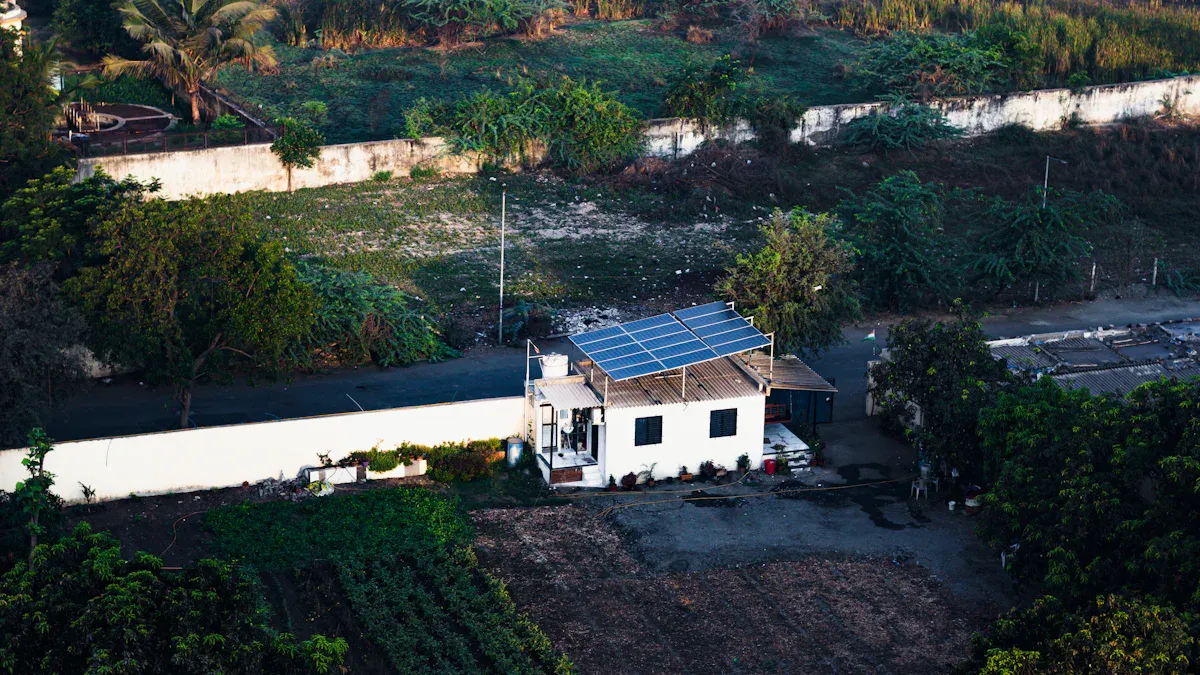
In West Africa, 92% of rural households lack reliable electricity. Integrating Energy Storage with solar technology delivers dependable, affordable power. This transformation improves daily life. Schools gain lighting, clinics power medical equipment, and businesses grow. The table below highlights positive economic impacts from solar mini-grids in rural Nigeria.
| Socio-Economic Variable | Influence on Income Generated by Mini-Grid Users | Direction/Notes |
|---|---|---|
| Gender | Significant | Females tend to generate more income than males |
| Household Size | Significant | Larger households correlate with higher income |
| Years of Business Establishment | Significant | Older businesses generate more revenue |
| Building Tenure (Private Ownership) | Significant | Paying rent correlates with lower income |
| Number of Employees | Significant | More employees linked to higher income |
| Previous Generator Ownership | Significant | Previous generator users have lower income |
Key Takeaways
- Integrating solar power with energy storage provides reliable, affordable electricity to rural African communities, improving daily life, education, and healthcare.
- Modular and scalable solar systems allow villages to expand their energy access easily while supporting local jobs and economic growth.
- Community involvement and innovative financing models make solar energy projects sustainable and accessible for low-income households.
Energy Storage and Rural Electrification Challenges
Barriers of Traditional Grid Expansion
Expanding traditional electrical grids into rural Africa presents significant obstacles. High capital and operational costs, often reaching $19,000 to $22,000 per kilometer for transmission lines, make grid extension financially unfeasible in sparsely populated regions. Low population density and limited productive electricity use further reduce the economic viability of such investments. Many rural households cannot afford the tariffs required to recover these costs. Technical reliability issues, including frequent power outages and the need for Energy Storage systems, add complexity and expense. Environmental concerns arise from the disposal of batteries and solar panels. Policy and regulatory barriers also hinder progress, as frameworks often do not support innovative microgrid business models.
- High infrastructure costs
- Economic infeasibility in low-density areas
- Unaffordable tariffs for rural households
- Technical and environmental challenges
- Policy and regulatory obstacles
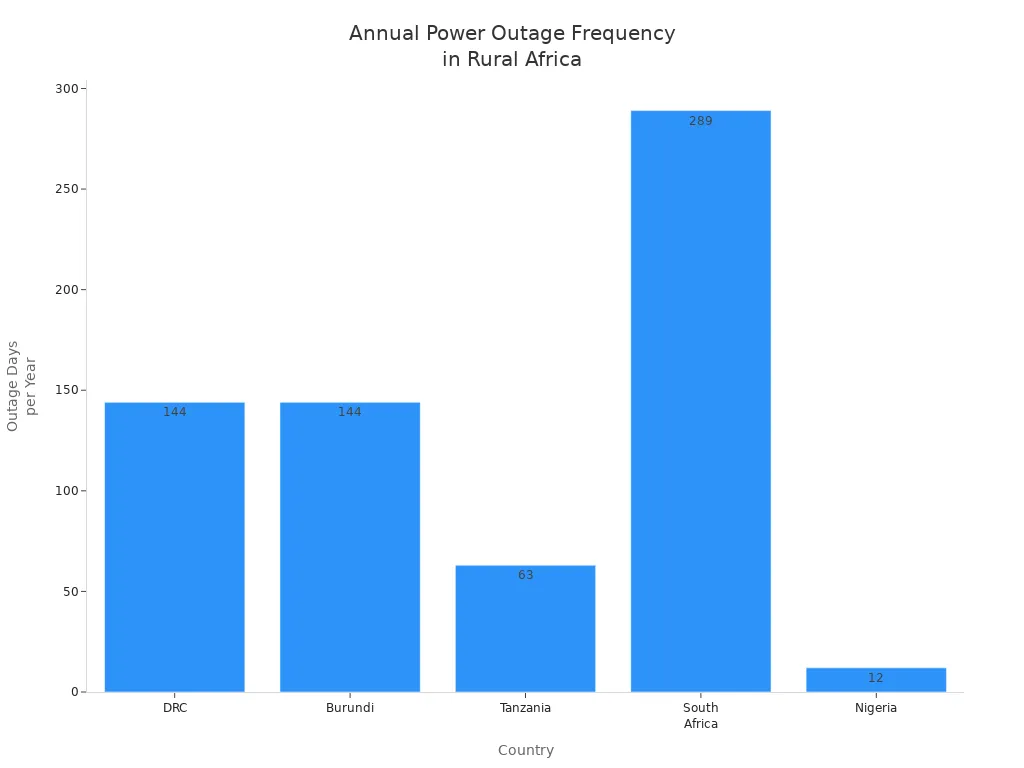
A comparison of outage frequency and duration in several African countries highlights the unreliability of traditional grids:
| Country | Average Outage Frequency | Duration of Outages | Notes on Impact and Causes |
|---|---|---|---|
| DRC | ~12 outages per month | Hours to days | Rural electrification under 1%, aging infrastructure |
| Burundi | Power cuts on ~144 days/year | Multi-hour to multi-day outages | Nearly every other day affected |
| Tanzania | Outages on ~63 days/year | Multi-hour to multi-day outages | Significant disruption to daily life |
| South Africa | Rolling blackouts on 289 days/2023 | Multi-hour to multi-day outages | Record interruptions, affecting cities and regions |
| Nigeria | 12 grid collapses in 2024 | Hours to days per blackout | Major economic and social consequences |
The Need for Reliable and Affordable Power
Rural African communities depend on traditional fuels like wood and dung, which are inefficient and harmful to health and the environment. Women spend significant time collecting wood and preparing food, limiting their participation in economic activities. Electrification reduces reliance on candles and wood, replacing them with electric lighting and cooking. This shift improves efficiency, health, and safety. Reliable and affordable electricity extends productive hours and enables more women to engage in market work. The benefits of electrification depend on free or low-cost connections, a steady power supply, and the ability to afford appliances. Energy Storage plays a crucial role in ensuring that power remains available even when sunlight is not, supporting daily life and economic growth.
How Solar and Energy Storage Solutions Work
Basics of Solar Power in Rural Africa
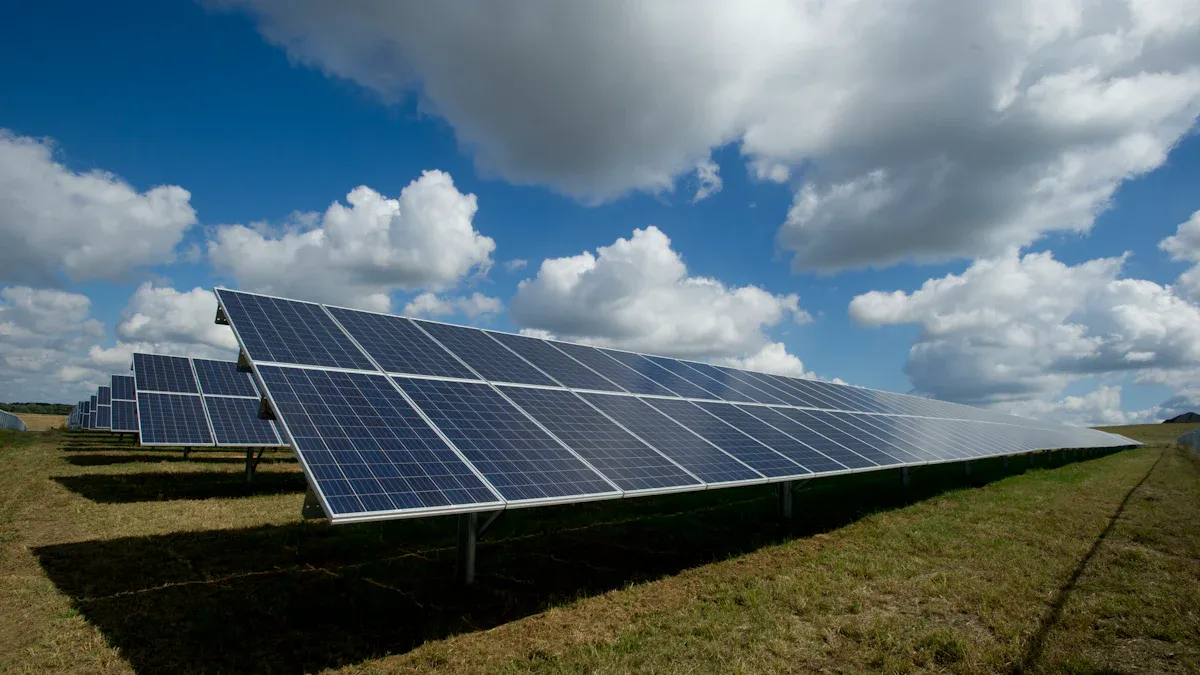
Rural Africa receives some of the highest solar irradiation in the world, with over 80% of the continent exposed to nearly 2000 kWh/m² annually. This abundant sunlight creates ideal conditions for solar power generation. However, adoption rates remain low due to financial, technical, and policy barriers rather than a lack of sunlight. Many regions, such as South Africa, face challenges like socio-economic inequality and unreliable infrastructure, which limit access to renewable energy.
Solar home systems and pico-solar devices have become the most common solutions for household electrification. These systems typically range from small multi-light kits to units providing up to 5 kW per household. They help reduce energy poverty by replacing candles and kerosene lamps with clean, reliable lighting. Affordability remains a key factor influencing adoption, as many families cannot afford the upfront costs of solar installations.
Note: Environmental factors such as dust, cloud cover, and high temperatures can reduce the efficiency of solar panels. Regular maintenance and proper installation help maximize energy output.
The most widely used batteries in small-scale rural systems are lead-acid types, valued for their cost-effectiveness and established recycling infrastructure. These batteries usually provide about 1.42 kWh of overnight storage with a 10-hour discharge period. Lithium-ion batteries, while more efficient and longer-lasting, remain less common due to higher costs and limited recycling options.
The Role of Energy Storage for 24/7 Electricity
Solar power alone cannot guarantee continuous electricity, especially during nighttime or cloudy days. Energy Storage systems bridge this gap by storing excess solar energy generated during the day and releasing it when sunlight is unavailable. This capability transforms intermittent solar power into a reliable, round-the-clock energy source.
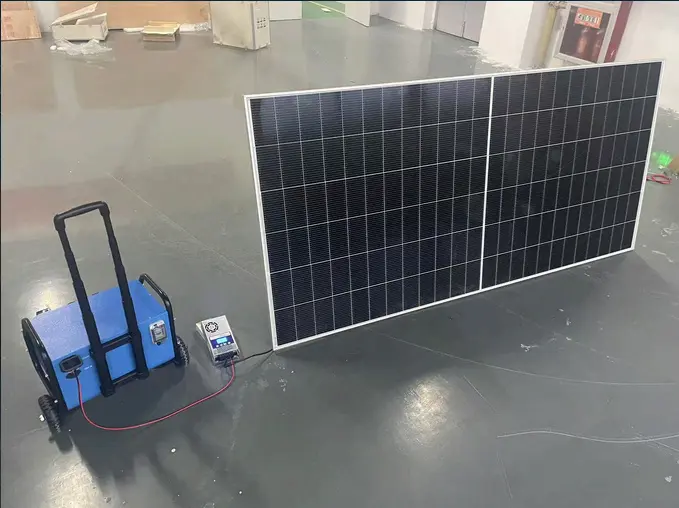
- Energy Storage systems typically include lithium-based batteries, inverters, and smart management units.
- These systems act as energy reservoirs, ensuring that households and community facilities have access to electricity at all times.
- Modern Energy Storage solutions are modular, weatherproof, and easy to maintain, making them ideal for remote, off-grid locations.
In rural Africa, lithium-ion batteries with about 10 kWh capacity can meet the daily needs of a typical household. Larger village microgrids often use batteries with capacities exceeding 100 kWh to balance supply and demand for entire communities. These hybrid solar and Energy Storage systems replace polluting diesel generators and kerosene lamps, improving air quality and reducing carbon emissions.
Real-world projects in Kenya and Tanzania demonstrate that integrating Energy Storage with solar power reduces urban migration, supports local entrepreneurship, and enhances nighttime security. Schools and clinics benefit by operating essential equipment, which improves education and healthcare outcomes. A feasibility study in rural Ethiopia showed that standalone solar-battery systems can reliably meet the energy needs of households, schools, and health facilities, enabling 24/7 electricity access.
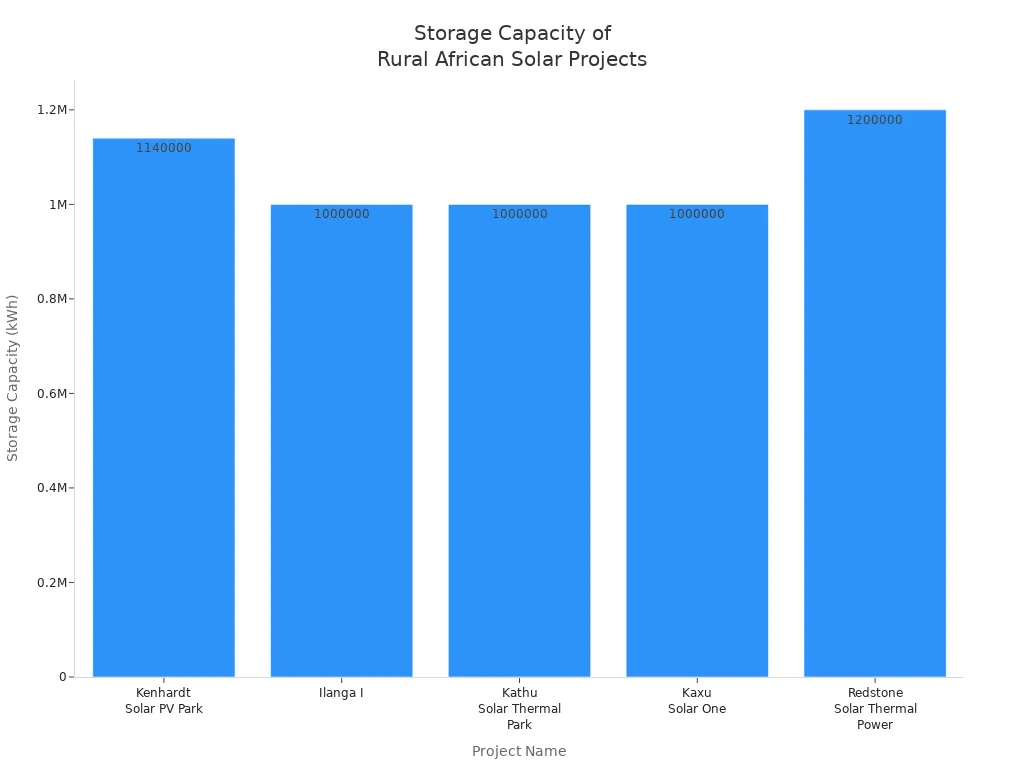
| Project Name | Location | Storage Technology | Typical Storage Capacity (kWh) |
|---|---|---|---|
| Kenhardt Solar PV Park | Northern Cape, South Africa | Lithium-ion batteries | 1,140,000 |
| Ilanga I | Northern Cape, South Africa | Molten salt thermal storage | ~1,000,000 |
| Kathu Solar Thermal Park | Northern Cape, South Africa | Molten salt thermal storage | ~1,000,000 |
| Kaxu Solar One | Northern Cape, South Africa | Molten salt thermal storage | ~1,000,000 |
| Redstone Solar Thermal Power | Northern Cape, South Africa | Molten salt thermal storage | 1,200,000 |
Modularity and Scalability for Villages
Modular and scalable solar solutions have revolutionized rural electrification in Africa. These systems, such as mesh grids and mini-grids, combine the flexibility of solar home systems with the reliability of utility grids. Their 'plug and play' design allows communities to expand or reconfigure their energy systems as demand grows, supporting both scalability and adaptability.
Mesh grids decentralize power generation, reducing dependence on centralized infrastructure. This approach lowers costs and increases resilience against natural disasters. The integration of IoT software enables remote monitoring, fault detection, and advanced energy management, which improves operational sustainability.
Research shows that optimized solar mini-grids, which incorporate photovoltaic generation, battery storage, and smart management systems, achieve competitive costs and high reliability. These systems support local economic growth and enhance community resilience. Lease-to-own models for appliances encourage productive use of electricity, fostering economic empowerment and long-term project sustainability.
Tip: Modular solar and Energy Storage solutions can be quickly deployed and easily maintained, making them especially suitable for remote villages with limited technical expertise.
Real-World Impact and Future Prospects
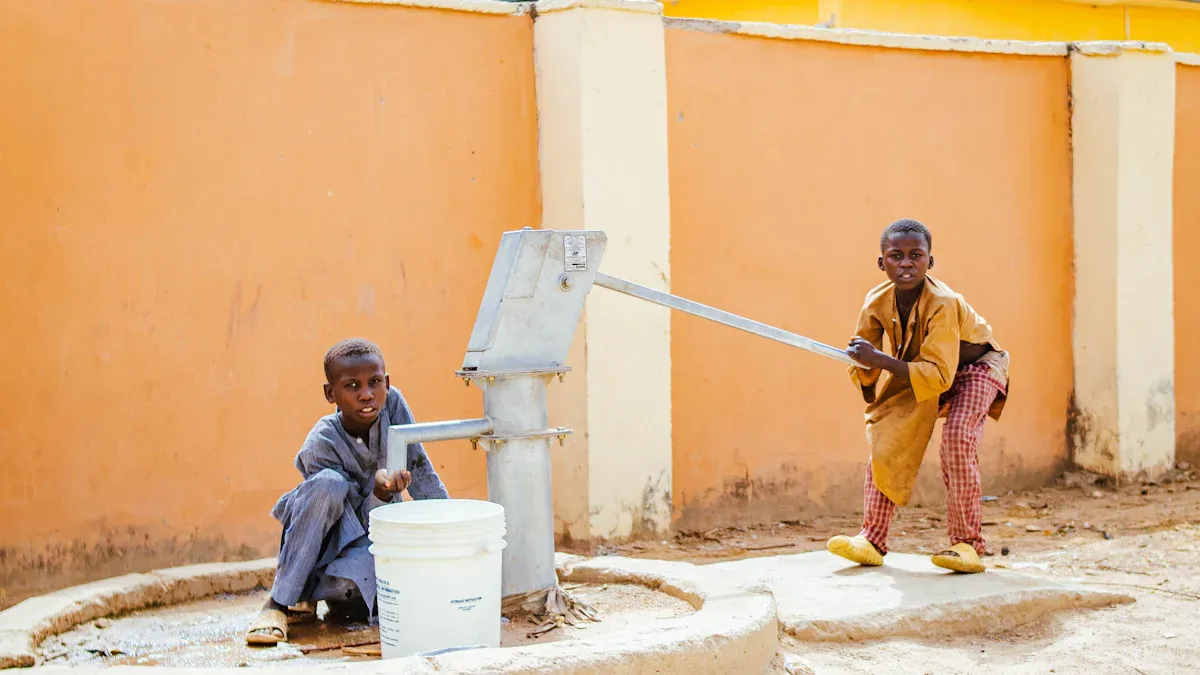
Case Studies: Lighting Up Schools and Clinics
Solar and Energy Storage systems have transformed essential services in rural Africa.
- In Uganda, health facilities gained reliable power through photovoltaic installations.
- Ghana’s clinics achieved 85-90% efficiency with fixed solar systems, improving healthcare delivery.
- Rwanda equipped 500 healthcare facilities with solar PV, reducing power interruptions.
- Kenya’s rural health institutions now provide more consistent, life-saving treatments.
In Namibia, mini-grids in Tsumkwe and Gam supply electricity to entire settlements, including schools and clinics. These hybrid systems combine solar, Energy Storage, and diesel backup, ensuring reliable power even at night. A large-scale study estimates that decentralized solar and battery systems could electrify over 55,000 rural healthcare facilities, reducing travel time to care for millions.
Economic Growth and Community Empowerment
Access to reliable electricity extends business hours, increases productivity, and creates jobs.
- Students benefit from evening lighting and digital tools, improving academic performance.
- Clinics can refrigerate vaccines and operate diagnostic equipment, enhancing healthcare.
- Households save money by reducing kerosene use and gain access to new appliances.
In Bisanti, Nigeria, a solar mini-grid powers homes, businesses, a school, and a clinic. Residents report improved quality of life, longer business hours, and better educational opportunities. Women, trained in technical and administrative roles, play a vital part in maintaining mini-grids and shaping project success.
Affordability, Financing, and Community Involvement
Effective financing models include government grants, private investment, crowdfunding, and pay-as-you-go systems.
- Community investment and local training programs foster ownership and sustainability.
- Partnerships with development banks and international funds help scale projects and reach vulnerable communities.
Pay-as-you-go models and collective investment strategies make solar projects accessible for low-income households.
Ongoing Challenges and the Road Ahead
Technical, financial, and policy barriers remain.
- Shortages of skilled personnel and logistical hurdles can disrupt operations.
- High upfront costs and limited financing options slow adoption.
- Supportive policies, regulatory reforms, and local capacity building are essential for future progress.
Projected trends highlight the importance of decentralized solar mini-grids, innovative financing, and community engagement. With continued investment and policy support, solar and Energy Storage solutions can deliver reliable, affordable power to millions more across rural Africa.
Modular solar solutions drive rural Africa’s transformation by delivering reliable, affordable, and sustainable electricity.
- Recent projects use plug-and-play microgrids, advanced battery systems, and community-driven models to overcome cost and access barriers.
- Lessons from Africa show that tailored designs, progressive tariffs, and strong local involvement ensure long-term success and inspire global adoption.
FAQ
How do solar and energy storage systems benefit rural schools?
Solar and energy storage systems provide reliable lighting and power for computers. Students study after dark. Teachers use digital tools. Schools operate more efficiently.
What makes modular solar solutions suitable for remote villages?
Modular solar solutions scale easily. Villages add panels or batteries as demand grows. Maintenance remains simple. Local technicians manage repairs and upgrades.
Are solar and battery systems environmentally friendly?
Solar and battery systems reduce carbon emissions. They replace diesel generators and kerosene lamps. Proper recycling of batteries ensures minimal environmental impact.