How to Choose the Right Inverter Ups for Your Power Needs?
When selecting an Inverter UPS, understanding your specific power needs is crucial. Inverter UPS systems provide backup power during outages, ensuring your devices run smoothly. They come in various capacities and features, which can make choosing the right one challenging.
Your unique requirements dictate the type of Inverter UPS you need. For example, consider the devices you want to protect and their power consumption. Not all models handle high loads effectively. It’s important to match the UPS capacity to your appliances.
Moreover, evaluating brand reputation and customer reviews adds another layer of assurance. Some brands are known for reliability, while others may have a record of failures. Don't overlook warranties and support services when making your choice. In the end, investing time in research pays off, guiding you towards a trustworthy Inverter UPS that meets both your power demands and budget.
Understanding Different Types of Inverter UPS Systems
When selecting an inverter UPS, understanding the different types available is crucial. The most common classifications include online, offline, and line-interactive systems. According to the Global UPS Market Report, the online UPS segment is projected to grow at a CAGR of 8.5% from 2023 to 2030. This type provides continuous power, ensuring zero transfer time during outages.
Offline UPS systems are generally more cost-effective. They are suitable for smaller applications where power interruptions are infrequent. However, they may not offer the best performance in critical environments. A study by ResearchAndMarkets indicates that line-interactive systems cater to the needs of businesses requiring a balance between functionality and cost. They manage voltage fluctuations and ensure sufficient power supply during outages.
Choosing the right UPS isn't just about specifications. Factors like energy efficiency and total cost of ownership come into play. Industry reports highlight that many businesses overlook these aspects, leading to suboptimal choices. Reflecting on the nuances of various technologies helps in making an informed decision that aligns with specific power needs.
How to Choose the Right Inverter UPS for Your Power Needs?
| Type of Inverter UPS |
Key Features |
Best For |
Estimated Runtime |
Ideal Capacity Range |
| Offline UPS |
Basic power backup, low cost |
Small home appliances |
5-15 minutes |
600VA to 800VA |
| Line-Interactive UPS |
Voltage regulation, fast transfer time |
Home and small office |
10-30 minutes |
800VA to 3kVA |
| Online UPS |
Constant voltage, zero transfer time |
Critical systems, servers |
30 minutes to hours |
1kVA to 10kVA |
| Smart UPS |
Advanced features, smart connectivity |
Business and IT networks |
15 minutes to several hours |
1kVA to 15kVA |
Evaluating Your Power Requirements and Load Capacity
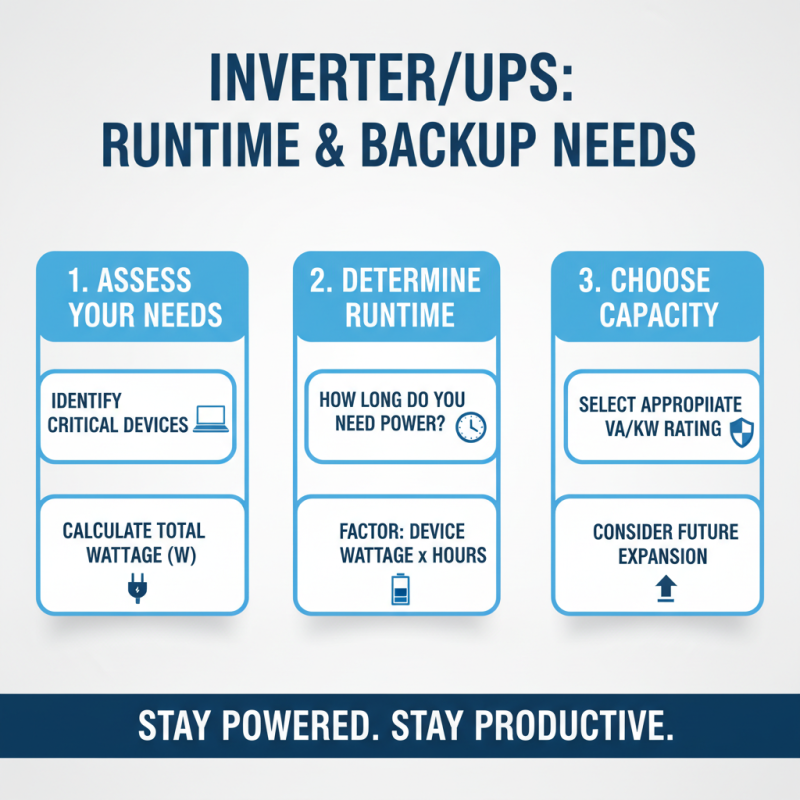
When selecting an inverter UPS, understanding your power needs is essential. Start by evaluating your total load capacity. List all the devices you plan to support. Pay attention to their wattage ratings. This helps you estimate the total power required. A common mistake is underestimating these numbers, which can lead to inadequate support during outages.
Consider surge power needs as well. Some devices require a higher wattage when starting up. If your UPS can't handle these surges, it could fail when you need it most. You might want to account for additional devices in the future. Having a little extra capacity is often a wise choice. Compare your calculations with the UPS specifications to find a good match.
Don't overlook the efficiency ratings of the UPS. A more efficient model may save you on energy consumption in the long run. Weighing these factors can be confusing. It’s easy to feel overwhelmed by technical specifications. Taking the time to analyze your situation helps ensure you choose wisely.
Power Requirements and Load Capacity Evaluation
This bar chart illustrates the typical power requirements for various devices and their corresponding load capacities needed for choosing the right inverter UPS. The values are based on average power consumption.
Considerations for Efficiency and Reliability in Inverter UPS
When considering inverter uninterruptible power supplies (UPS),
efficiency and
reliability are key.
A well-designed inverter UPS not only protects devices but also optimally manages energy consumption.
Reports indicate that systems with efficiency ratings above 90% can reduce electricity costs significantly.
For instance, a study by the International Energy Agency found that improving UPS efficiency by just 10%
can lower energy consumption by 20%.
Reliability is equally crucial. Downtime can lead to data loss and increase operational costs.
Research shows that high-quality inverters can last over a decade, whereas cheaper alternatives may fail prematurely.
A survey by the IEEE revealed that 40%
of organizations experienced outages due to inadequate power systems.
Investing in a trusted UPS can provide peace of mind and safeguard critical operations.
Moreover, consider the capacity and
load requirements. Selecting a UPS that meets or slightly exceeds your power needs
can enhance performance. Systems should ideally allow for future expansions. However, oversizing can lead to inefficiencies.
Balancing these factors ensures that the chosen inverter UPS serves effectively.
Assessing these elements can lead to informed decisions and longer-lasting power solutions.
Budgeting for Your Inverter UPS Purchase and Maintenance
When budgeting for an inverter UPS, accuracy is key. Start by assessing your power needs. Identify devices that require protection during outages. Calculate their total wattage to determine the UPS capacity you need. This helps in avoiding over-expenditure on unnecessary features.
Maintenance costs should also be factored in. Regular checks and battery replacements can add up. Aiming for a low upfront cost might lead to higher long-term expenses. Evaluate each model's maintenance requirements before purchase. Some systems need frequent servicing, which can strain your budget.
Don’t overlook hidden fees, like installation and taxes. These can significantly raise your initial investment. Consider warranties and service plans as well. A more expensive UPS may offer better support, thus saving money over time. Balancing cost with reliability and performance is critical for a smart purchase. It's essential to invest wisely in tools that protect your investment.

 Mobile Generator